A small monument that becomes meaningful when you slow down
Among Gyeongju’s many large and impressive historical sites, Cheomseongdae often looks modest at first glance.
When visiting with children, the first reaction is usually simple:
“It’s smaller than I expected.”
“That’s it?”
But Cheomseongdae is not a place meant to impress at first sight.
It is a site that reveals its meaning gradually—especially when you understand its story and experience it both during the day and at night.
What Cheomseongdae actually was
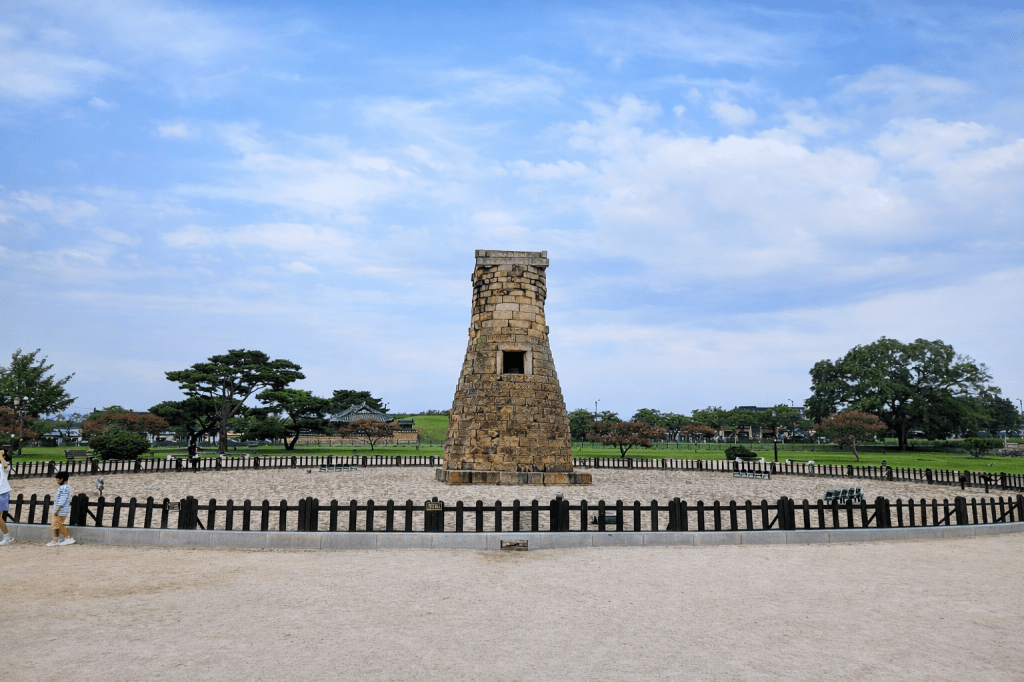
Cheomseongdae Observatory was built during the Silla period as an astronomical observatory, a place used to observe the movement of the sky.
The structure stands about 9 meters tall and is made up of three clear sections:
- A square stone base that supports the structure
- A cylindrical middle section, shaped like a bottle
- A grid-shaped stone top, arranged in a井(井)-pattern
The cylindrical body is built with 27 layers of fan-shaped stones.
While the exterior is smooth and carefully finished, the interior is rough, with the backs of the stones exposed.
There is a small opening facing southeast.
Historical records suggest that observers placed a ladder outside, entered through this opening, and climbed inside to reach the top in order to observe the sky.
This was not a decorative monument.
It was a structure designed for real use.
Why observing the sky mattered in Silla
In the Silla period, astronomy was directly connected to everyday life and state affairs.
- Observing the sky helped determine agricultural seasons
- Changes in celestial movement were believed to reflect the fortune of the nation
Because of this, astronomy was considered a matter of national importance.
Cheomseongdae is believed to have been built during the reign of Queen Seondeok in the 7th century.
Today, it is regarded as the oldest surviving astronomical observatory in East Asia, showing the advanced scientific thinking of the Silla Kingdom.
How we explained it to our kids
You don’t need a technical explanation.
This was enough for our children:
“People long ago wanted to understand the seasons.”
“So they watched the stars and built this tower.”
With just that, Cheomseongdae stopped being “a strange stone tower” and became a place where people once studied the sky.
Daytime vs nighttime: two very different experiences
During the day, Cheomseongdae is best for understanding its structure.
You can clearly see the layers of stone, the proportions, and the position of the opening.
At night, however, the atmosphere changes completely.
Experiencing Cheomseongdae through media art
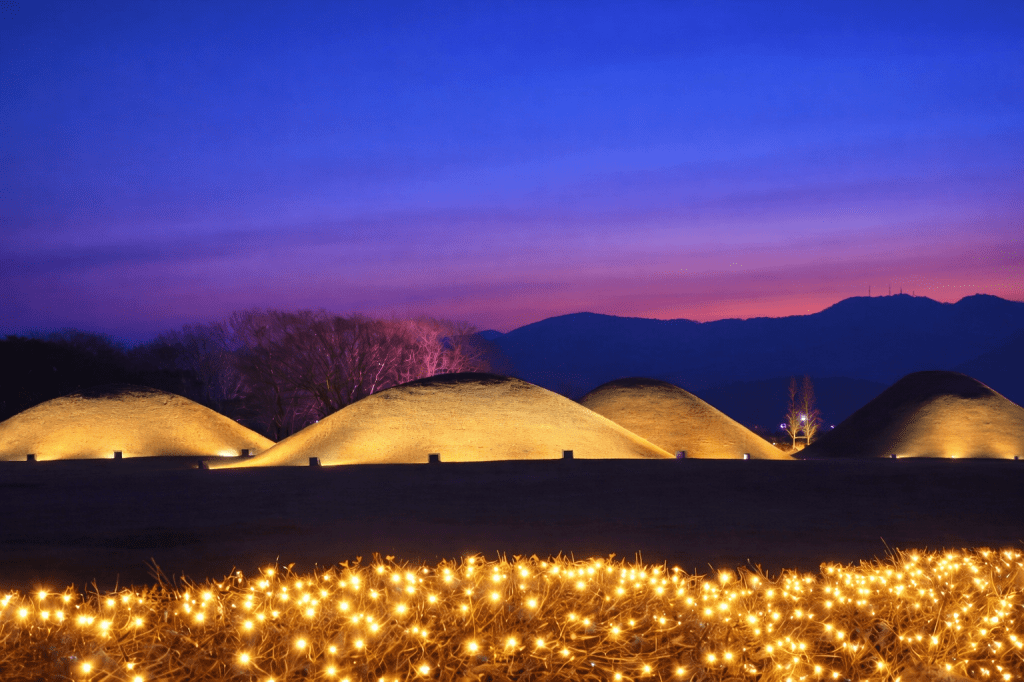
In recent years, Cheomseongdae has also been accompanied by nighttime lighting and media art installations.
Using light and simple visual effects, the themes of stars, sky, and time are reinterpreted in a modern way.
It is not a long or dramatic show, but rather a short, quiet experience that fits naturally into an evening walk.
Cheomseongdae Media Art Schedule (reference)
- Session 1: 18:30 – 18:37
- Session 2: 19:30 – 19:37
- Session 3: 20:30 – 20:37
- Program period: until November 2, 2025 (subject to change)
The short duration worked well with children.
They stayed focused, and the connection between the daytime explanation and the nighttime visuals felt natural.
“Those look like stars.”
“So this really was a place for watching the sky.”
Not a photo spot, but a meaningful pause
Cheomseongdae’s media art is not something you visit for perfect photos.
It is better experienced by standing still for a few minutes and sharing a quiet moment with your kids.
Rather than rushing through, this is a place that invites reflection.
A brief stop with lasting impact
Cheomseongdae is not a site where you spend hours.
But when visited thoughtfully—especially with children—it often becomes one of the most memorable places of the day.
Later, when we asked which place felt the most interesting,
Cheomseongdae was mentioned more often than expected.
Final takeaway
Cheomseongdae may look small,
but it quietly shows how the Silla people observed the sky, understood time,
and connected science with daily life.

 G morning B night
댓글 남기기