A 1,000-Year-Old Secret Hidden in Stone
Seokguram Grotto is often described as one of Korea’s most important historical sites, yet many visitors leave feeling unsure about what they just saw.
There is only one stone statue.
The space is small.
And the visit itself is brief.
But Seokguram is not a place meant to impress at first glance.
It is a place that reveals its meaning only when you understand why it was built this way.
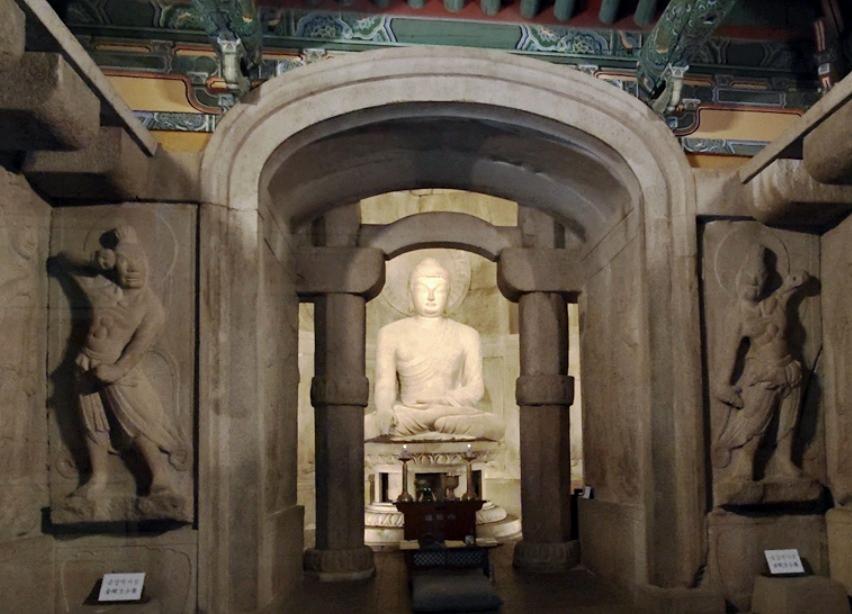
1. What Is Seokguram Grotto?
The original name of Seokguram was Seokbulsan Temple, a stone sanctuary entirely carved and assembled by hand.
It is not a natural cave. Every stone was intentionally shaped and placed, making it a fully engineered stone grotto.
Unlike the large cave complexes of India or China, Seokguram consists of only one grotto, and it is relatively small in scale.
But Seokguram was never meant to show power through size.
It was designed to be complete as a single space.
2. Why Was Seokguram Built?
Seokguram was not created simply to house a Buddha statue.
Under the direction of Kim Daeseong, one of Silla’s most influential figures, the finest artisans of the kingdom gathered with a single question in mind:
Could the world of the Buddha be perfectly recreated on earth?
Seokguram was the answer to that question.
It was designed as a physical expression of Buddhist philosophy—a space where structure, symbolism, and belief come together as one.
3. How Was Seokguram Constructed?
The Role of Cold Spring Water and Airflow
Although Seokguram is an artificial stone structure, its internal environment was designed to regulate itself naturally.
The grotto was built above a natural cold spring, whose stable temperature helped regulate the stone floor throughout the year.
In summer, it reduced excess heat.
In winter, it softened sudden temperature changes.
Equally important was airflow.
Seokguram was not completely sealed. The structure allowed air to move slowly in and out, driven by natural temperature differences between the interior and exterior.
This gentle circulation prevented moisture from lingering and stopped condensation from forming on the stone surfaces.
In other words, Seokguram relied not on mechanical systems, but on natural physics—a remarkably advanced concept for a structure completed between 751 and 774.
4. Modest in Appearance, Complete in Design
A Space Where Ancient Science Still Lives
At first glance, Seokguram appears simple.
There are no dramatic decorations or overwhelming details.
Yet its true sophistication lies in what you cannot see:
balanced proportions, calculated weight distribution, controlled humidity, and symbolic geometry.
The single seated Buddha at the center is surrounded by figures arranged in a circular formation, reflecting a complete Buddhist universe.
Nothing is excessive. Nothing is missing.
Seokguram does not need grandeur.
It stands as a quiet statement of confidence from Silla’s master craftsmen—proof that one space, perfectly designed, is enough.
5. Is Seokguram Worth Visiting?
To be honest, there is little else to see nearby.
It is not a photo-heavy destination, and it is not a place where you linger.
But if you arrive knowing why it exists,
why it is small,
why there is only one statue,
and why its design mattered more than decoration—
Seokguram becomes unforgettable.
This is not a place to consume quickly.
It is a place to understand, then witness.
For travelers who value meaning over spectacle,
Seokguram is absolutely worth the journey.

 G morning B night
댓글 남기기